Download Transcript
Spencer Levy
When we talk about assets such as office and real estate these days, we tend to focus on a lot more than location or efficiency. Indeed, current thinking says physical space should create enthusiasm simply for being there, which in turn helps get things done. On this episode, two leaders with global responsibilities share insights about those ideas, advice for operating and managing massive portfolios, and the challenge of leading multi-generational teams in the modern workplace.
Nicole Nicholson
We kind of joked as a team when we would talk to architects or talk to the business because the number one ask was: We all have lunch together, we have our coffee together every day – or excuse me, our cafecito – and so that was so paramount to the design of the entire space.
Spencer Levy
That's Nicole Nicholson, Vice President of Global Real Estate at Verizon. Along with its global network, Verizon manages a portfolio of about 115 million square feet of offices, retail stores and other worldwide real estate.
Jamie Hodari
I'm just looking around and it feels to me like 2026 is the year of the communal experience.
Spencer Levy
And that's Jamie Hodari, the CEO of CBRE Building Operations and Experience, which manages almost 8.5 billion square feet of commercial property and corporate facilities around the world, and Industrius, the flexible office company that CBRE acquired last year. Coming up, we host a pair of dynamic leaders and a live audience at CBRE's Lever House offices in New York City for a conversation devoted to the ways real estate operations and culture can support business at the bottom line. I'm Spencer Levy and that's right now on The Weekly Take.
Spencer Levy
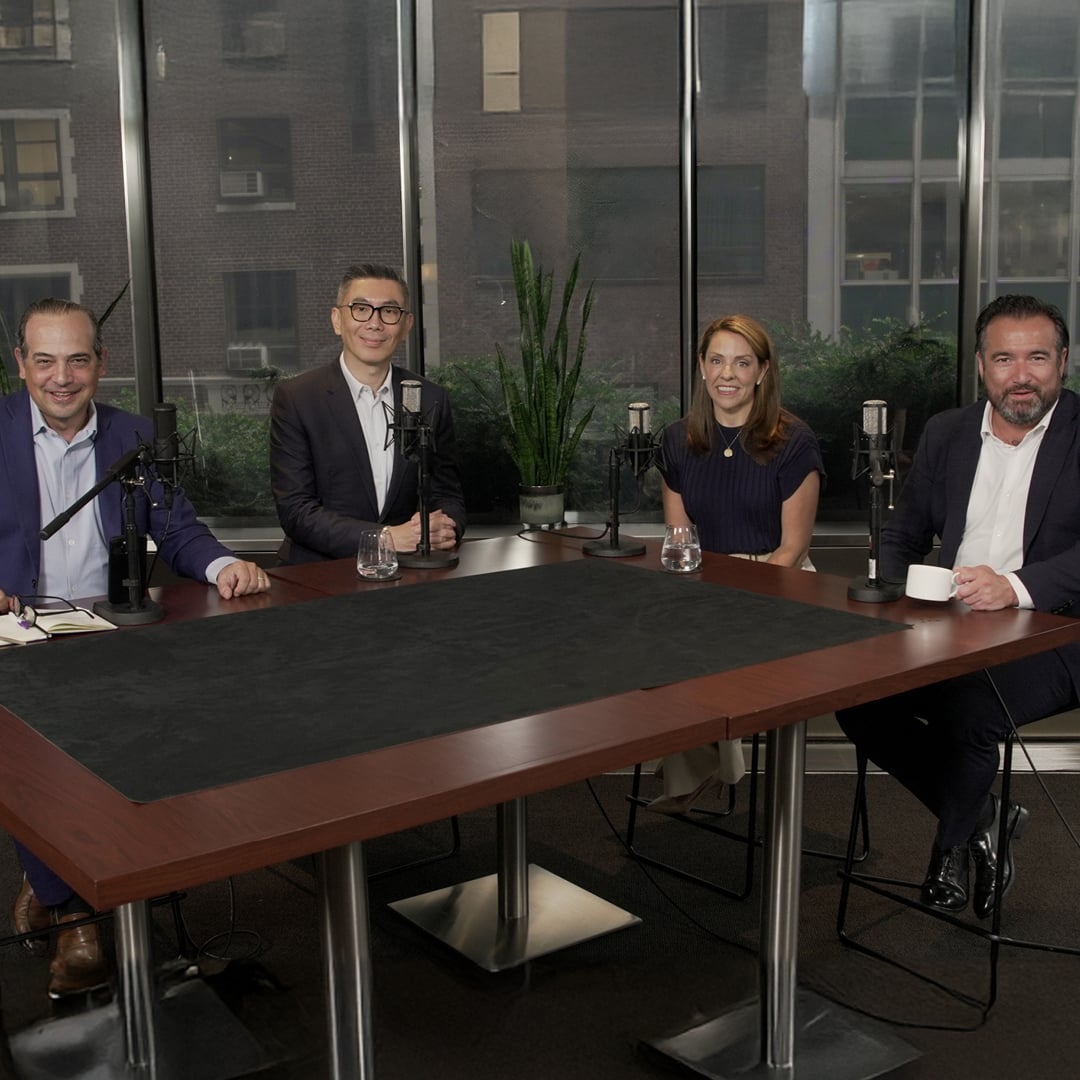
Welcome to The Weekly Take here from the Lever House in New York City. And what a cool space, Jamie. Well done, sir. And so we are delighted to have Nicole Nicholson, Vice President of Global Real Estate for Verizon. Welcome, Nicole.
Nicole Nicholson
Thank you.
Spencer Levy
And I appreciate you wearing CBRE green. That's good branding.
Nicole Nicholson
Absolutely.
Spencer Levy
That's a good branding. Pretty cool: 115 million square feet, that's all over the world. That's kind of a small portfolio.
Nicole Nicholson
Pretty boring, yeah.
Spencer Levy
How many countries?
Nicole Nicholson
Thirty – I believe, about 30 countries. Gonna check my math, but, yeah.
Spencer Levy
Pretty cool. Pretty cool. And Jamie Hodari, the CEO of Building Operations and Experience, for what I believe is your fifth appearance on the show.
Jamie Hodari
Ugh, is that true?
Spencer Levy
I think it is, five. We counted it up before.
Jamie Hodari
I'm a huge SNL fan and the five-timers club is actually a big thing.
Spencer Levy
We need to get Jamie one of those vests.
Jamie Hodari
I like to think of myself as, like, the Steve Martin of The Weekly Take.
Spencer Levy
Well, you know what, from now on, Jamie, you are.
Jamie Hodari
Thank you.
Spencer Levy
Well, speaking of amazing – and I know this is getting micro. We should start macro – amazing new space here and Industrious had a lot to do with it.
Jamie Hodari
Yeah, so okay, if you're listening on your phone and you can't see images of it, we are in Lever House, which is a very, very classical, fancy New York City building. It's the original modernist office building in New York. If you closed your eyes and tried to picture a mid-century, Mad Men, glass and steel little jewel box of a building, you would be picturing. Lever House. And CBRE just made a big bet on moving our global financial headquarters here and we're really loving it. It's an argument for the office because the number of drinks after work and pop in to say hi and casual conversations I've had has literally doubled or tripled since we moved here two months ago.
Spencer Levy
Nicole, you've been running real estate for a long time at Verizon. How important is the physical real estate to your business?
Nicole Nicholson
To our business it's very important. So, when you think about what the bread and butter of our real estate portfolio is, 85 million is technical aspects – so central offices, everything that runs not only our Fios product or you know the old telephone lines – but truly the backbone of our entire network infrastructure. So where we're positioned and where that real estate is so important. Not only just like the power or the buildings and where you're positioned in a particular neighborhood, but then we also obviously have our retail business and figuring out how do we make sure that we're as close as we can be to our customers and being part of their daily life, not something that they've got to go and seek out, but just something they drive by every day. And so that comes into practice as we think about retail. And then for our admin, it's creating those cultural experiences and how do you have people who want to come to the office and have those sort of natural collaboration points, which I think is so important.
Spencer Levy
Well, I think, Jamie, you're a huge advocate for that, for the cultural aspect of the office. And I often say, even though in most instances, office is a want not a need. You’re creating demand. You are creating the reason for people to come to the office, is that a fair way to put it?
Jamie Hodari
Yes, and this might be a little bit. I don't know getting out ahead of it. I'm not a cultural commentator, but my family's from Argentina. I'm a huge World Cup fan. I was obviously all the way behind the New York Knicks. And I'm just looking around and it feels to me like 2026 is the year of the communal experience. People are paying. People are making fun of these people that are waiting in line for two hours in the West Village to get frozen yogurt. And they look at them and be like, that must be miserable. And then when you walk by them. They're chatting with their friends, they're talking to people behind them in line, and they're actually wanting to be in line because they just–they want that. They wanna get outside the home. They wanna be in that communal experience. So for me, it feels very much being in that concept of the office as a place people want to be, somewhere you're drawing them to is very of the moment for me. It's kind of what I think, especially in the U.S. right now, it just plays into what people want right now. They wanna get outside their house and they wanna be shoulder to shoulder with other people. Having a good time, learning new things, experiencing things with others.
Spencer Levy
Nicole, staying on this topic of the cultural importance – the wanting to be there, the togetherness as Jamie has put it – you have offices all over the country. We talked in the pre-show about your Miami office, about a showcase for these concepts. Tell us about it.
Nicole Nicholson
Our Miami office is really cool. It was a really exciting project. We had an acquisition of the TracFone company. They had been in the same headquarters for years. It was your traditional sort of outdated office, tons of carpet, ugly carpet, not nice carpet like this. Lots of offices, lots of infrastructure issues, etc. We acquired the company and it was really underutilized space, not where people want to be. But you did have this community of people who were so invested in the business of TracFone, that almost didn't matter about the space that they had. We had an opportunity to sell that asset and move them to a bit more of the up-and-coming areas of Miami, reposition them into a high rise building and really take account of that cultural impact of those people, the business they do and the type of spaces that they want, the experiences they want. We kind of joked as a team when we would talk to architects or talk to the business because the number one ask was: We all have lunch together, we have our coffee together every day – or excuse me, our cafecito – and so that was so paramount to the design of the entire space. And we just opened it a couple of months ago. And when you go, it really is the heart of the space; It’s this little cafe. Everyone goes there and you have this just energy that is radiating from that space in terms of the business that they do every day. So it was an exciting project.
Jamie Hodari
I just, I love that anecdote and I really feel like, even the New York Times, but like a lot of press has gotten this thing about food at work wrong. They kind of make fun of this idea of you have to bribe people with pizza. Like my father's 91, he's from Argentina, but he moved 11 years ago to a little village in Italy. And he moved there because people live longer in Italy because they're living this very communal life. They're all seeing each other and they're all seen each other over an espresso in the town square. And so there's just something so natural and so human about wanting to bond with others, share ideas with others, connect with others over a cup of coffee or a pizza, sure. And I don't find that to be in any way about bribing Gen Z. It's about creating the spaces like all the other parts of our life that allow us to get together and enjoy each other's company. And it sounds like in Miami, you guys nailed that. I would love to see that space.
Nicole Nicholson
It's really cool, and I agree with you, because it's not about the, sure, we like a free coffee now and again. But it really is about how do you just have the people who have those natural points that they're talking about, their families, their life, the soccer game, but then also touching upon work, it makes it a lot easier to get things done. I think we've all seen that. So it's a huge success there.
Spencer Levy
You are two of the most senior leaders in our industry. And you're both, and I say this with respect, you're young. How is it being a young leader leading such a large portfolio for Verizon?
Nicole Nicholson
It was actually–this is kind of funny. So I did a town hall last week in Atlanta with my team and this one individual who I hadn't met in person yet and we did the session and we're all talking and she came up to me afterwards and she was like, you know, like that was actually really good. When I saw you got announced, like, I thought, like, what does she know? She's 22. And it's like, Oh my god, do you really think that I'm 22?
Jamie Hodari
Mazel tov.
Nicole Nicholson
Like, thank you so much. Wow. Yeah, but I was just talking about that story before, but no, I think I feel much older in that I said I've been at Verizon for 18 years and sort of have this feel like a worldly experience of my time there. But I think that given the way the macroeconomic environment has been throughout that career, it brings a lot of different opportunities for us. And Verizon has lived three lives, it feels like, in that time that I've been there as well. So being able to pivot, kind of keep abreast of whatever the latest opportunities are culturally, what's happening in real estate, what’s happening with companies like CBRE. I've had a ton of conversations with Jamie about–I'm so excited to see the transformation that you guys are all going through and how you're thinking differently about how we all show up as real estate professionals and a climate in which just your plain old office, plain old retail isn't really enough and how do we bring that to life and what we're doing. I try to do that in my experience there.
Spencer Levy
So Jamie, I wanna ask you the same question, but I'm gonna put a little CBRE research spin on it, if I could. We did a research piece about a year ago that talked about the five generations, talking about the Boomers, the Xers, the Millennials, the Zs, and we talked a little bit about the Silent Generation, And then we talked about AI being another generation. So you're a–I presume you're Millennial?
Jamie Hodari
Yeah, I'm the oldest you can be and still be a Millennial. I'm 44.
Spencer Levy
But how is it being a young leader with these five or six generations that are working with you?
Jamie Hodari
At 28 or 29, I became the executive director of an organization. This organization's board took a bet on me. So that was really extreme, because that was particularly young, I think, to be in an executive role. And what I found is that people really love authenticity and they can just smell out the moment that there's anything that runs counter to that. And the thing is we're always in life being given advice. That is, basically some version of don't be your authentic self. So even when I took the CBRE role, people who I really trust were like, OK, you're in the big leagues. This is the biggest property manager in the world, the biggest facilities manager in world, you've got to tone down your Jamie-ness a little bit. And it was not bad advice on the surface. So for the first five, six months, I wouldn't do karaoke at the conference. And things were going well and I really feel like the moment where I was like, what am I doing? Like I'm not, no one's, everyone has met me. They know that like, obviously he loves karaoke. Obviously he's gonna get on the dance floor. Obviously he is not gonna be wearing, you know, like a Zegna suit five days a week and leaned in a little more to being me. It worked so much better. So that probably relates to generation, age and every other element of who we are, it’s that I think trying to fight against who you are or hide certain elements of how you show up at work is not a particularly successful strategy. And then when you talk about these companies that have a really wide range, I would almost zoom out and say one of the things I think is very cool about Verizon, this is one of the reasons I was really excited that you were going to be the guest and I would love to get into this, is I think these companies are not all one thing. You have white collar roles, blue collar roles, technical roles, people who sit all day on a laptop, and lots and lots of people who are the exact opposite. I mean 70 or 80% of your real estate is not office. I think that's a really wonderful thing. At CBRE, in our building operations and experience segment, it's about 100,000 people, an enormous number of those are working in somewhat physical roles on site at certain buildings. If you work in communications at a company, and you've worked in comms your whole life, you've lived primarily working in front of a laptop in the world of ones and zeros. So the most natural thing in the world would be, let's send the email at 2 p.m. And everyone's gonna read it and they're gonna know about this new change. And it's so easy to underestimate how many people are like, oh, I don't even use my CBRE email address because I'm on site working in the client's environment, or I'm 40 feet underground, I have no cell reception there and stuff like that. So to be able to close your eyes and picture what's the full breadth of the people in this organization at any given moment in time, how are they living? And what does it mean to communicate with them or get in front of them is really hard, but also I think kind of more exciting and sexier than being in an organization that's ultra narrow in its demographic and in its way of working.
Nicole Nicholson
Jamie, you hit on the perfect word of authenticity. I think, it’s so paramount. So I think you have to show up as what you truly know, what you bring to the table, not trying to know everything about everything, but bringing the right people to those conversations, to those problems. It's very much how I lead. As you just said, we've got people who are running our retail stores. There are people who are running fiber lines, that are decomming our network, that are selling copper, that are selling phones, that are dealing with call centers. And I've not done a fraction of those jobs, but understanding who does know about those roles or know about how those people think or what their questions may be or kind of the real estate that they're looking for, right, to bring it back to just like a very tactical part of the job is so important. And so bringing those right people to the conversation is what I think about. But from an authentic perspective, just to hit on this as well, I think to be a leader of a massive organization, it's so important to just be who you are and show up for your people in a certain way. For me, I'm a mom, I have three kids. I'm very open with my team about when I do travel, I try to do it in one night. I take the first flight out, I take a redeye home. I have to sometimes step out for, like, cookies with mom or whatever the case may be. And sort of making that very known. I didn't have a lot of women who had families or kids or whatever that have been in prior roles or in prior leadership, people that I worked with. And so I think it's really important to show up as who you are and what's important to you. And for me, it's not only my job that's incredibly important leading a large team of people, large portfolio of assets, but making sure that I can reflect on my team, hey, if you have something really important to you, maybe it's kids, maybe your grandmother, maybe it your dog, maybe whatever else you have in your life, making sure you make time for that and sort of give you that head space.
Spencer Levy
Maybe this is a little tactical, but there's 100,000 people in the BoE division. Tactically, how do you communicate with them – via email, via memo, via phone calls, via being in person – and be effective with that large of a group?
Jamie Hodari
Let me start by saying I feel like Nicole's answer just now was the answer of the whole episode. It was like, nothing's gonna get better than that. So we could cancel the second half of the episode, we can keep going, but–
Spencer Levy
We will get you that vest over the fifth appearance, Jamie.
Jamie Hodari
We hit the summit and I'm still figuring that out. At Industrious, I managed 1,000 people. At CBRE, I manage 100,000 that is so different in kind that you can't just use your same tactics from the one for the other. And Industrious, I really, like everyone at that company felt like they knew me. Like knew me, knew my kid's names, I knew what they were about, I knew it annoyed people, I knew–
Spencer Levy
Your favorite karaoke song? What is your favorite karaoke song?
Jamie Hodari
I'm experimenting with different ones at any given moment in time. I think right now there's a ska song called The Impression That I Get. It's like, na-na-na-na, knock on wood, na, na. I don't know the words clearly, but I have this sense that it would kill at karaoke, so I've been practicing it in the shower, obviously not enough. So anyway, so what I would say is, I'm on a journey of figuring out how do you communicate with 100,000 people and not 1,000. The one that I've done that I have changed the most is like, I am posting on LinkedIn a lot. And I get a little embarrassed because I could see someone being like, hey is this guy serious? Like he's got a day job, is he wasting time that he could spend at work trying to be a LinkedIn influencer or something. But for whatever reason it is hard to get people to open the corporate email with a little header that's a message from your segment CEO. And every time I post a little video on LinkedIn – the more casual the better, the more unscripted the better – I get like thousands of responses, like, oh, that was really helpful. So that's been a big success and I'll keep doing that.
Spencer Levy
By the way I'm a huge believer in LinkedIn. Obviously you know I'm pretty active there. So Nicole what again this may be a little tactical but you got a huge team all over the world Jamie believes in LinkedIn and being authentic what do you believe in?
Nicole Nicholson
I definitely believe in the casual conversations you just hit on. I think we've been trying to do a lot more of that in our team. We've been doing these update and insights, like lunch and learns, very old school when you think about that. But we do these sessions on different topics. Right now, we're really focused on monetization. But when you ask half of just even my team, what does that really mean? They have no idea. They're like, I don't know, you're selling real estate, what does that mean to me? What do I have to be thinking about? So tomorrow, as an example, the team's gonna do a session where they're going to give Real Estate 101, basic facts about how are we thinking about real estate? How do we work with firms like CBRE? What are our opportunities? Where do we have highest and best class real estate that is currently used as an underutilized central office, right? But giving people just nuggets of things that are happening. We've been doing a ton of town halls, being present. You can't do that across 100,000 across the globe all the time. But I think just doing these casual conversations of here's what's really happening in the team, not using a bunch of fancy slides all the time, just talking in plain terms about what the business is looking to achieve, what our team is doing and being available to them. I always finish every conversation or every webcast with, you know, where to find me, slack me, text me, call me, like I'm not a formal person. If you wanna talk, you have an idea, you don't need to overthink how you wanna tell me your idea or problem you see or opportunity, Just come and tell me. And just being available to do that, and like truly following up and being present and trying to understand what makes them tick, what are they looking to learn and sharing what we need to achieve as a business. But then just also knowing them as much as you can in those moments that you can.
Jamie Hodar
And I would say in the era of AI slop, what she just described cuts through the noise even more than it would have 10 years ago.
Spencer Levy
Let's rewind the tape for a minute here. Ten years ago people were saying retail was dead. And then people realize it's a long way from dead because people want a sense of community and they get it in retail. And I think Covid–originally we said all we're all gonna work from home. No, it accelerated: I want to be with other people, community. What do you think?
Nicole Nicholson
I 100% agree. I think Jamie and I talked about an article from the New York Times a couple weeks ago around people who work from home and have none of that communal experience – basically you see these higher levels of anxiety and depression and all of these mental health issues because all you start doing is sort of focusing on what's in front of you, right? Being in this maybe a small apartment if you're in New York City, the work that you have and you don't kind of pull yourself out to those lighter moments with your team or with your family or with, you know, wherever else that you could be besides just in this kind of singular experience of at home. So absolutely.
Jamie Hodari
That article that Nicole referenced was a very controversial article. I’m so, if you–I'm a true believer in it, but yeah.
Spencer Levy
Well, I guess when we're talking about community is, what is the office, okay? And we're here in the physical office, the physical space, but to me, the office is wherever your clients and colleagues are. It doesn't have to be physically here. And one of those places is after work, socializing after work. Obviously, you know, rules have changed and behaviors are obviously different than they used to be and for a good reason. But can you still socialize after work Jamie?
Jamie Hodari
The statistics are that the going out for work after-work happy hour has declined a lot. I really hope it makes a comeback. I love a beer with colleagues. This is so anecdotal. I think it's coming back not in a crazy way. And if you don't drink people have a mocktail or whatever, But I think we we hit peak introvert two or three years after COVID. And I think people also hit peak, like, I want my dinner reservation to be at 5 p.m. I want to be home by 6:45 p.m. and you really can't push it that much farther. Like, there is no such thing as a 4:40 dinner reservation And so almost like there has to be some reversion to the mean. And I have a sense that we're in a post-work socializing, lunch with friends, etc. swing back probably not all the way to 1965 or something but..
Spencer Levy
I know what all the way back looks like. I grew up here in New York City, and my dad was taking me to Sparks Steakhouse right down the street in 1978.
Jamie Hodari
Oh, it's so fun.
Spencer Levy
And those lunches were three hours long, and I learned that a vodka martini could be paired with anything. But it was a very different time, a very different time. But I think, I'm not suggesting you should or shouldn't drink or anything like that, but I am suggesting I'm agreeing with you. There needs to be more of a social aspect to what we do.
Nicole Nicholson
Well, I was gonna say, I feel like the mocktail culture has hit like a new high. It makes me– I do enjoy a beer or a glass of wine, but I'm constantly fascinated. I'm curious if this came up in your earlier podcast recording, but you go to every nice restaurant and they have a comprehensive mocktail menu. So to your point, it is available to everyone.
Spencer Levy
Yeah.
Nicole Nicholson
I think this kind of goes back to the point of if you don't have that built community, whether it is with your colleagues – in anywhere you work, whether it's at the retail store, whether it's underground somewhere or in an office place – it is hard to translate that nowadays to the beer after work. But I think if you can build those natural relationships in person. It makes it a lot easier to then have some camaraderie or some friendship that you want to extend beyond the office place. And when you kind of said like work happens anywhere, I have some of my team here today and we joke, every time we travel together, we rent a white minivan. And we get the most work done in that minivan, then you would get maybe in a week in the office or anywhere else because you're just firing off, okay, I just got this call, I got this email, and you have every decision maker, everyone who can influence someone in that minivan, and we're solving problems left and right as we go to each site visit or whatever it is we're doing.
Spencer Levy
One of the things I hear a lot from our large, occupier clients is that very often – too often perhaps – their conversations with landlords are very tactical. Are you gonna pay me a dollar more in rent? Am I gonna get another 10 bucks in my TI allowance? Am I just gonna buy this space, do a sale leaseback? But both of you have tremendous, and I say this respectfully, tremendous market power to have a more strategic conversation with a landlord rather than tactical. How do you see it?
Nicole Nicholson
I would agree. I think for us, it really depends. So I think it depends on if we're talking our retail or technical, but trying to truly build up our relationship with the landlords, how we think strategically about a market or about an asset class and where there's opportunity for us to both benefit in terms of how we're thinking about the future, what flexibility we may need to scale up or down.
Spencer Levy
So Jamie, how do we make people think bigger when you're dealing with a client like a Verizon or of their scale to be more strategic with them to say, well, we're not just dealing with your New York lease. We're dealing with your national portfolio of retail or your national portfolio and we're gonna deal with you on that front. Even if it means we lose a dollar here to gain a dollar there because my job isn't to charge you a dollar. My job is to make you money.
Jamie Hodari
Well, let me first say having an adversarial relationship in business is such an unpleasant thing. It happens. But to me, the fact that people would assume that an office relationship between the landlord and occupier is in some way, at some fundamental level zero-sum or by nature is going to be a bit adversarial is like–I think about people who have an apartment in New York. You hate your landlord. Or your landlord doesn't want you to be there, whatever. I mean, everyone can acknowledge the emotional toll of that. I don't think it's that different in a commercial setting. Everyone assumes commercial settings are less weighty, that there's less emotions involved in them. But I would say the situations I've seen where people treat in the office the relationship with the occupier and the landlord as zero sum, it gets just as ugly and just as unpleasant if that was happening in your own damn home. So I'm violently opposed to that as an orientation towards how real estate works. I think the way to move beyond some of this transactional stuff, and this is maybe an obvious point, but it's kind of that start-with-why premise. And at Industrious, just to give listeners two seconds of context, Industrious is a coworking company, and coworking companies were historically chaotic. And I don't want to give all the obvious examples, but they were doing okay, they're going bankrupt, they were going okay, and part of the reason was that the long-term model doesn't work in that industry. So Industrious was the first company that switched to doing management agreements, where you partner with the landlord, you build it out together, and you all rise or fall together. And that took forcing that more partnership approach. And the easiest way I think to get there is to be almost annoying, like a six-year-old, like why? Well, why? Well, why? So let's say you're working with Verizon, Verizon's like, hey, you know, we want to double our space downtown. If you're like, great, well we can do it for you at this commission or blah blah, you've already lost it. If you're like, okay, well, why, what are we trying to, okay, I get it, okay. So you're trying to give a little bit more breathing room for people and you want to make a bet on the New York City labor market, great. I can get behind that, that sounds amazing. Actually, we have this service that helps do a little of analysis of labor market moves and impact on rent so we can–and next thing you know, it's like, once you've both gotten to the why behind the transaction or the why the service, you're almost invariably gonna end up shoulder to shoulder and be able to do it. And if you can't explain why a customer is doing a thing, that's probably a pretty good sign that you're going to be unlikely to be a great partner to them.
Nicole Nicholson
Well, I think, and you hit on the back to partnership, right? It's not just this transactional, yes, I need a lease here, or I'm looking to renew here, and yeah, I've got a global portfolio, I've a lot of similar landlords, et cetera. It's really about the strategy of the business and what are you looking to achieve? What are the other value-adds that companies like yourself offer in terms of labor markets that are so helpful when we're making those decisions and sort of bringing in those resources to the conversation? Make it actually a valuable conversation in terms of beyond even just that one deal or whatever you're talking about. It starts to be a true relationship that you can build upon. You come top of mind for the next market, the next lease, next whatever. So I think that partnership piece is paramount.
Jamie Hodari
Maybe one thing I would say that's just advice to listeners: I find strategic to be kind of a fluffy word sometimes. But it happens to all of us. Your boss in the last week was like, let's take a more strategic approach to this. And it can be kind terrifying, because it's like, I don't exactly know what strategic means, and do I know when I'm being strategic or not? And so I think that's where trying to reframe it is, do I feel aligned with my customer right now or not? Do I feel like I really get what they're trying to do or not or do I not really understand it? Or trying to pull this concept of strategic, pull it apart into something that's a little more plain English and a little like I could recognize it when I see it is probably the easiest way to then deliver on this idea of a more strategic relationship, a more strategic memo for your boss, a strategic hiring plan or whatever it is.
Spencer Levy
Let's talk about the future. And we are here in 2026. We're sitting here in Manhattan. You're both global in nature. And the world right now has high interest rates. We have high inflation. There's geopolitical issues out there right now. But that's the negative. The positive is community is getting more and more important. People want to be together. How do you see Verizon in its real estate over the next several years?
Nicole Nicholson
Very different. So I think, Jamie, it was a good lead-in as we think about the technological world and all the things we're hearing and talking about with AI. And we as Verizon, we've got these assets that we've had for 150 or 125 years in all of these cities. You have all this fiber, all this power, this connectivity. You've got this environment of where we're questioning data centers. Do we want them around? Do we not want them around, right, from a regulation perspective? You're hearing all this pressure. And we, as Verizon, we've got these assets that are sitting there as we think about our legacy technology, as that starts to migrate, take up less power, take up more physical space, how do we then use that as a real asset to the communities and the people and the business as AI computing goes up and you have that access in multiple pockets of spaces, right, or across multiple assets in every city, every town and every farmland. So really that breadth of how we think about real estate and that digital conversion, physical world, as we think of the intersection there is where I think we're really focusing on from a real estate perspective right now.
Spencer Levy
So combining two comments here, Jamie had a colorful comment about AI slop before about not being such a good thing in the tactical sense, in the today's sense, in the don't do an AI post on LinkedIn, and if please, producers, keep that in. If you're gonna post on Linkedin, make sure it's your voice, not Mr. or Ms. AI. But AI is here, it's coming, it's going to make us more efficient, it's gonna do a lot for us. AI: how much is that specifically going to change your business?
Nicole Nicholson
Very much so. So I think Verizon is very focused on being the preeminent AI user from a telecom perspective. But not only just from the efficiencies that I think you sort of hear about, but truly about how does it transform our business and how do we enable that to do things better for, whether it be that proximity from a data perspective, whether be how we think about looking at data differently, servicing our customers better to give them truly what they need servicing. The issue of the Fios that goes out in your home, right? How do you use those technologies for sort of the good versus just the AI slop?
Spencer Levy
Jamie, how do you see the next couple of years? How does AI play into it?
Jamie Hodari
All right, let me start personal. And it is easier to talk about this than making pronouncements. What I see is – and I can't quite tell why – like, let's say you could use AI to automate the mundane, rote, not particularly interesting things in your personal and work life, or you can use it to help you think, to help, you know, start writing for you, to start generating ideas for you. I kind of assumed everyone was gonna line on like, I really want to use it to get all the shitty annoying work I have to get done away to free up my time to write, to think. And what I see happening – and I don't think people are necessarily doing it deliberately is – I do see a lot of people where the reverse is true. They're still manually sorting all their emails and changing all of their calendar invites, and triaging their task lists. And then when they have to write a memo to their boss or to lay out something very important, they're like starting with Claude and ceding their own thinking. So that would maybe be my very basic thing is like we're somehow reversing it. I would use AI – like a criminally large amount of AI to automate all the stuff in your work and personal life that's non-value add but I would protect a little bit, letting it infect too much the stuff that's extraordinarily value add. And I do think writing and thinking and problem solving and critical thinking and communicating with friends and stuff is more in the latter category for me.
Spencer Levy
So I have a wrap-up question. Since one person in this audience was kind enough to send in a text question, who will go nameless though they are a good friend of mine. So the question is, we have talked a lot about infrastructure, but wondering how Verizon is thinking about their customer experience being shaped by the retail presence. And when I say retail presence, I'll interpret it in my words. Retail presence is both the–you're in the store, you buy stuff, you have a customer. It’s also a billboard. And then you also have, I guess the third part of the question is, the local market individuality of them versus them being more similar to others. So look at retail–
Nicole Nicholson
So I think we hit on this and really is back to Jamie's point that the whole crux of this conversation is community. So I think when we think about our retail stores, I mentioned it's so important to be part of the community of wherever you're servicing so you're just part of people's daily lives,
Spencer Levy
Yeah.
Nicole Nicholson
Whether they're thinking about getting a new phone or, you know, coming into that store that day. But you just want that visibility where it's part of their commute. They're thinking of Verizonf subconsciously at any time. So when we think about markets and how they shift and grow, I saw that firsthand kind of recently in Phoenix, it seems like every week it's changing in terms of where people are living or where they wanna be or where they want to shop. And so keeping abreast of where that is, what are those challenges and how do we make sure that we're showing up in the right place. And then also from a community perspective, we've really focused a ton on servicing the community that we're in with the house of brands from Verizon. So not just our postpaid, what you're kind of thinking about is their traditional Verizon brand, but also the value brands – so the TracFone acquisition and other brands like that. And being in communities and connecting people to maybe where they're from. Argentina is a great example, right? Like when people emigrate to the U.S. from Argentina, what are they looking for? What is the type of phone? Where are they coming? Do we make sure that we have someone who could connect with them and build that community so that they feel comfortable to use Verizon.
Spencer Levy
So we're just about out of time. I'll ask one last wrap up question. First of all, thank you both for a wonderful conversation today. But we've gone through a massive change in the office sector in the last couple years. And I think we're both–all agreeing the pendulum is swinging back. We've gone though a massive change in the capital markets where actually capital markets have gotten a little harder from the standpoint of interest rates being higher. But I think the next couple of years are gonna be some of the most fun times ever to be in real estate. And the reason why is because the last couple of years, or certainly from 2009 to 2022, it was a capital markets market, cap rates were compressing, everybody was making money. Now operators win. So that's why I'm optimistic about the future of real estate. Next couple of years, do operators win?
Nicole Nicholson
I hope so. Yeah, I think we do. I think from when we think about the infrastructure in Verizon as an occupier, I that we're looking to leverage real estate, which I think as much as you put real estate as an asset to any company and really are investing in how it can grow the business, I think you hit on it when we were talking about how do we grow the revenue of a company with the real estate or how we can impact a community, etc. Like I think that's where I'm most excited from a Verizon real estate perspective.
Spencer Levy
Well, Jamie, you should know I have had in my base deck for the last two years, your quote: quote unquote, Everything is operational real estate. I play that on almost every speech I have. So, assuming you still agree with that, Jamie and you are gonna get that on your vest, it's a good quote from Jamie Hodari. But I think the next couple years are even gonna be more operational than they've been the last couple of years because of the changes in the capital markets, because people want more community and that's why I think it's really cool time to be in real estate,
Jamie Hodari
Good riddance. To me, I used to work at a hedge fund and I didn't like it. At some point I was like, I'm just trading paper and it's all abstract and we're buying and selling this and it doesn't–and I think there is an old way of talking about real estate in that same way. It's just a store value. 226 Madison is up 10% and this is done. It is abstract. And it does not need to be abstract. I kind of get that pork futures need to abstract. But this is an actual building that real-life humans walk into every day, and they're either having a great time or they're not. Or they're, like, dreading having to get on the subway to go there. And so the more that our industry leans into the fact that these are operating entities that exist in the real world and are providing some kind of service to the people that use them every day. And they can either do a great job of it or a bad job of it, and that difference is enormous, is going to be great for real estate. And for those of us who work in real estate, it's a thousand times more interesting than the pure asset model of how to think about real estate.
Spencer Levy
So the bottom line, it's going to be a lot cooler to think about operations and to think about–
Jamie Hodari
This might be the hippest industry out there, if I had to be honest.
Spencer Levy
That is the new quote that will make my base presentation. So on behalf of The Weekly Take, let's hear it for Nicole Nicholson, VP of Real Estate for Verizon, and Jamie Hodari, CBRE’s CEO of Building Operations and Experience.
Spencer Levy
Thank you all for visiting a live taping of The Weekly Take. For other perspectives on these timely ideas about real estate operations and experience, check out our website, CBRE.com/TheWeeklyTake. You can stay on top of our archived conversations and current programming there or on the podcast platform where you listen. That includes a relatively new and growing presence on YouTube where this episode and select others are posted in full HD color. So check it out and leave a comment to let us know what you think. We'll be back next week with more from the wider world of commercial real estate. Thanks for joining us. I'm Spencer Levy. Be smart. Be safe. Be well.


.jpg)